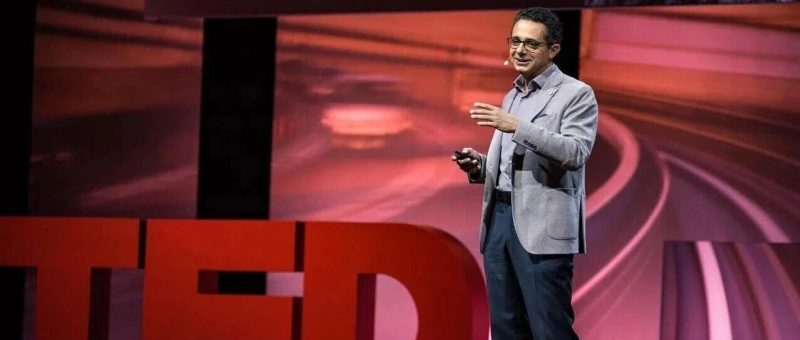


演讲题目:
Need a new idea? Start at the edge of what is known
演讲者:
中英对照
We have all probably wondered how great minds achieved what they achieved, right? And the more astonishing their achievements are, the more we call them geniuses, perhaps aliens coming from a different planet, definitely not someone like us. But is that true?
我们可能都曾好奇过,聪明人是怎样有所成就的,对吗?并且他们的所作所为越令人惊叹,我们越习惯于叫他们天才,或者是“外星人”,来自另外的星球,反正绝对不像我们这样普通。但是,真的是这样吗?
So let me start with an example. You all know the story of Newton's apple, right? OK. Is that true? Probably not.
让我来举个例子说明。我们都知道牛顿的苹果。那个故事真的发生过吗?可能没有。
Still, it's difficult to think that no apple at all was there. I mean some stepping stone, some specific conditions that made universal gravitation not impossible to conceive. And definitely this was not impossible, at least for Newton.
当然,我们很难想象传说中的苹果其实并不存在。我的意思是,宇宙万有引力定律的发现是基于特定环境或媒介的铺垫。这种说法有一定道理,至少对于牛顿来说是这样。
It was possible, and for some reason, it was also there, available at some point, easy to pick as an apple. Here is the apple. And what about Einstein?
这是可能的,因为一些原因,它就在那里,像够到那个苹果一样容易,触手可及。那么对于爱因斯坦呢?
Was relativity theory another big leap in the history of ideas no one else could even conceive? Or rather, was it again something adjacent and possible, to Einstein of course, and he got there by small steps and his
very peculiar scientific path? Of course we cannot conceive this path, but this doesn't mean that the path was not there.
相对论是历史上又一大新思想的飞跃。除了爱因斯坦,就没人可以提出了吗?或者说,相对论当时就在我们身边,对于爱因斯坦也是一样,他一步步走在自己的科学发现之路上,最终发现了相对论。当然我们无从知道这是一条怎样的路,但这不能否认那条路的存在。
So all of this seems very evocative, but I would say hardly concrete if we really want to grasp the origin of great ideas and more generally the way in which the new enters our lives. As a physicist, as a scientist, I have learned that posing the right questions is half of the solution. But I think now we start having a great conceptual framework to conceive and address the right questions.
这两个例子好像暗示了一些什么,却又不具象,尤其当我们真的希望找到变得更优秀的源头,或通俗一点说,我们怎样在生活中发现新鲜事物的时候。作为一个物理学家,科学家,我知道,提出正确的问题,问题就解决了一半。而我想,我们现在已经拥有了很棒的概念性的框架来发现和解决问题。
So let me drive you to the edge of what is known, or at least, what I know, and let me show you that what is known could be a powerful and fascinating starting point to grasp the deep meaning of words like novelty, innovation, creativity perhaps. So we are discussing the "new," and of course, the science behind it. The new can enter our lives in many different ways, can be very personal, like I meet a new person, I read a new book, or I listen to a new song.
那么现在,让我带大家进入身边所熟悉的领域,或至少,是我熟悉的。让我来说明一下,从熟悉的领域开始去感知新奇,创新,或者创造这类词语更深层的含义,是一个多么好的起点。我们在讨论“新”,同时还有它背后的科学。“新”可以由不同的方式进入我们的生活,可以是很私人的,比如,我认识了一个新朋友,读了一本新书或者听了一首新歌;
Or it could be global, I mean, something we call innovation. It could be a new theory, a new technology, but it could also be a new book if you're the writer, or it could be a new song if you're the composer. In all of these global cases, the new is for everyone, but experiencing the new can be also frightening, so the new can also frighten us.
也可以是普遍化的,比如,我们所说的创新,可以是新理论,新技术,同样也可以是一本新书,前提是你是个作家,也可以是一首新歌,如果你是个作曲家。这所有的例子里的“新”,是每个人都有机会接触发现的。但体验“新”却也常常令人担忧,因为我们面对“新”,会有畏惧感。
But still, experiencing the new means exploring a very peculiar space, the space of what could be, the space of the possible, the space of possibilities. It's a very weird space, so I'll try to get you through this space. So it could be a physical space.
同时,体验“新”意味着我们在探索一段奇特的领域,它具有任意性,还有可能性。这是个很神奇的领域,不过我会尝试带大家领略一下。它可以是某个物理空间。
So in this case, for instance, novelty could be climbing Machu Picchu for the first time, as I did in 2016. It could be a conceptual space, so acquiring new information, making sense of it, in a word, learning. It could be a biological space.
比如,我在2016年第一次爬上马丘比丘(古代印加城遗址,在今秘鲁中南部)。也可以是理论上的空间,如获取新的信息,简而言之,就是学习。它还可以是生物层次的。
I mean, think about the never-ending fight of viruses and bacteria with our immune system. And now comes the bad news. We are very, very bad at grasping this space.
想想我们的免疫系统与病毒及细菌之间永不停歇的对抗。但是先别忙着乐观,我们非常不擅于察觉到“新”的存在。
Think of it. Let's make an experiment. Try to think about all the possible things you could do in the next, say, 24 hours. Here the key word is "all." Of course you can conceive a few options, like having a drink, writing a letter, also sleeping during this boring talk, if you can.
想一想是不是这样,我们来做个实验。尝试思考在未来的24小时内,你可以做的所有可能的事情。记住,关键词是“所有”。下意识地,你会有几个选择,比如喝一杯饮料,写封信,或者在我无聊的陈述中打个小盹,如果你们想的话。
But not all of them. So think about an alien invasion, now, here, in Milan, or me -- I stopped thinking for 15 minutes. So it's very difficult to conceive this space, but actually we have an excuse.
但这不是所有我们要做的事情。想一想外星人入侵,对,就是现在,在米兰,或者是我,在接下来的15分钟内停下来不去思考。所以,要察觉到所有可能发生的事情并不容易。但这可以理解。
So it's not so easy to conceive this space because we are trying to conceive the occurrence of something brand new, so something that never occurred before, so we don't have clues. A typical solution could be looking at the future with the eyes of the past, so relying on all the time series of past events and hoping that this is enough to predict the future. But we know this is not working.
不容易实现的原因是我们都尝试着去发现一些绝对的“新”,一些以前从未发生的事情,所以我们找不到任何线索。那么有什么解决办法吗?用目睹了过去的眼睛看未来,就是凭借着在过去发生的事,这些经历能支持我们预测未来。但实际上,这种方法的效果差强人意。
For instance, this was the first attempt for weather forecasts, and it failed. And it failed because of the great complexity of the underlying phenomenon. So now we know that predictions had to be based on modeling, which means creating a synthetic model of the system, simulating this model and then projecting the system into the future through this model.
就跟首次播报天气失败了一样。因为事情多发生在表面,而内部的复杂性却被忽略了。所以,我们会通过建模来帮助预测,就是建立一个系统的综合模型,通过模型模拟,预测系统的未来发展。
And now we can do this in a lot of cases with the help of a lot of data. Looking at the future with the eye of the past could be misleading also for machines. Think about it.
在很多情况下,基于大量数据,我们都可以建模。但用过去的眼睛(数据)预测未来(系统),也可能会出错,对计算机来说也是一样。设想一个画面,
Now picture yourself for a second in the middle of the Australian Outback. You stand there under the sun. So you see something weird happening.
你在澳大利亚内陆地区,站在太阳底下,看到了一些奇怪的事情。
The car suddenly stops very, very far from a kangaroo crossing the street. You look closer and you realize that the car has no driver. It is not restarting, even after the kangaroo is not there anymore.
远远地,一辆车突然停住了,在它前面很远处有一只袋鼠在过马路。你仔细一看,发现车里竟没有司机。袋鼠过完马路后,汽车也没有重新启动。
So for some reasons, the algorithms driving the car cannot make sense of this strange beast jumping here and there on the street. So it just stops. Now, I should tell you, this is a true story.
因为一些原因,这辆无人驾驶汽车内置的算法并不能理解这种现象,一只奇怪的庞然大物在街上蹦来蹦去。于是它就停下了。这是个真实的故事。
It happened a few months ago to Volvo's self-driving cars in the middle of the Australian Outback. (Laughter) It is a general problem, and I guess this will affect more and more in the near future artificial intelligence and machine learning. It's also a very old problem, I would say 17th century, but I guess now we have new tools and new clues to start solving it.
几个月前,沃尔沃的无人驾驶汽车就这样停在了澳洲内陆中部地区。(笑声)这个问题很普遍,我想在不久的将来,人工智能和机器学习会在方方面面产生影响。这个问题存在很久了,17世纪就出现了。但我相信,现在的我们拥有更多的新工具和方法去解决它。
So let me take a step back, five years back. Italy. Rome. Winter. So the winter of 2012 was very special in Rome.
让我们暂时回到过去,五年前,意大利,罗马,冬天。2012的冬天,对罗马来说是很特别的,
Rome witnessed one of the greatest snowfalls of its history. That winter was special also for me and my colleagues, because we had an insight about the possible mathematical scheme -- again, possible, possible mathematical scheme, to conceive the occurrence of the new. I remember that day because it was snowing, so due to the snowfall, we were blocked, stuck in my department, and we couldn't go home, so we got another coffee, we relaxed and we kept discussing.
因为一场史无前例,美不胜收的飘雪。这个冬天对我和我的同事们来说也有着特殊的意义,因为我们理解了一种近乎合理的数学模型——强调一下,只是可能,用来帮助发现“新”。我记得那天在下雪,也正是因为这场雪,我们被困在了办公室,无法回家,所以我们决定喝杯咖啡,放松一下,同时继续讨论我们的研究,
But at some point -- maybe not that date, precisely -- at some point we made the connection between the problem of the new and a beautiful concept proposed years before by Stuart Kauffman, the adjacent possible. So the adjacent possible consists of all those things. It could be ideas, it could be molecules, it could be technological products that are one step away from what actually exists, and you can achieve them through incremental modifications and recombinations of the existing material.
忽然之间——准确地说,可能并不在那段小憩的时间——在某个时间点,我们在发现“新”,与斯图亚特·考夫曼曾经提出的一个美妙的理论之间建立起了一种联系,即临界的可能性。临界的可能性可以包含很多东西,比如新点子,新分子,或者新科技产品。我们距离这些实际存在的“新”,只有一步之遥。我们可以通过改变身边存在的事物,或对其加以重组来发现“新”。
So for instance, if I speak about the space of my friends, my adjacent possible would be the set of all friends of my friends not already my friends. I hope that's clear. But now if I meet a new person, say Briar, all her friends would immediately enter my adjacent possible, pushing its boundaries further.
举个例子,比如我身边有一群朋友,那么身边可能的“新”,可以是一群我朋友的朋友,他们目前还不是我的朋友。希望我说的够清楚。如果我现在认识一个新朋友,比如布莱尔,那么她的朋友们就会立即成为我的“新”朋友的备选人,这样我的人脉就会越来越多。
So if you really want to look from the mathematical point of view -- I'm sure you want -- you can actually look at this picture. So suppose now this is your universe. I know I'm asking a lot.
如果你们想用数学角度来看待这件事——我确信你们有这个想法——我们可以来看一眼这张图。这就是你的世界。我知道我要求有点多。
I mean, this is your universe. Now you are the red spot. And the green spot is the adjacent possible for you, so something you've never touched before. So you do your normal life.
麻烦大家把自己置身于这张图,这个红点,就是我们现在所处的位置。绿点便是我们身边可能的“新”,即我们从未踏入的领域。我们过着正常的生活,
You move. You move in the space. You have a drink. You meet friends. You read a book. At some point, you end up on the green spot, so you meet Briar for the first time.
在自己的世界中一步一步走,喝杯水,见个朋友,读本书,在某个时间点,我们就走到了这个绿点,比如,我们在这里第一次见到了布莱尔,
And what happens? So what happens is there is a new part, a brand new part of the space, becoming possible for you in this very moment, even without any possibility for you to foresee this before touching that point. And behind this there will be a huge set of points that could become possible at some later stages.
然后呢?在这个特殊时刻,我们会涉足一个崭新的领域,我们从未投身的领域,即使我们从未预想能走到这片未知的领域。在踏入这片新区域后,会有更多新领域,在未来的某个时段可能被我们开启。
So you see the space of the possible is very peculiar, because it's not predefined. It's not something we can predefine. It's something that gets continuously shaped and reshaped by our actions and our choices.
所以我们看到了,身边可能的未知领域是很神奇的,因为它的不可预知。我们没有办法提前得知,这片区域是随着我们的行动和选择被随时塑造的。
So we were so fascinated by these connections we made -- scientists are like this. And based on this, we conceived our mathematical formulation for the adjacent possible, 20 years after the original Kauffman proposals. In our theory -- this is a key point -- I mean, it's crucially based on a complex interplay between the way in which this space of possibilities expands and gets restructured, and the way in which we explore it.
当时发现这一点联系时,我们非常高兴——科学家就是这样。基于这一点,我们发现了可以计算临界可能性的数学公式,在考夫曼理论提出的20年后。在我们的理论中,有一个关键点。这个公式依赖于“新”区域的拓展及其重建之间复杂的相互影响,以及我们自身探索“新”的方式。
After the epiphany of 2012, we got back to work, real work, because we had to work out this theory, and we came up with a certain number of predictions to be tested in real life. Of course, we need a testable framework to study innovation. So let me drive you across a few predictions we made.
在2012年的顿悟后,我们回到工作中,进行实地考察,因为要将理论应用于实践。我们提出了几个需要用实际生活来检验的预测。当然,我们需要一个测试体系,来研究这个新方法。让我简单介绍一下我们所做的预测。
The first one concerns the pace of innovation, so the rate at which you observe novelties in very different systems. So our theory predicts that the rate of innovation should follow a universal curve, like this one. This is the rate of innovation versus time in very different conditions.
第一个是创新的步调,即不同的体系中发现“新”的速度。我们的理论预测出这种速度应该遵循通用曲线,比如这张图。这是不同条件下新方法的速率与时间的比值。
And somehow, we predict that the rate of innovation should decrease steadily over time. So somehow, innovation is predicted to become more difficult as your progress over time. It's neat. It's interesting. It's beautiful. We were happy.
通常,我们预测发现“新”的速率随着时间变长稳定降低,由于某些限制,随着我们行动的增加发现“新”会变得更加困难。这个系统很巧妙,有趣且迷人,我们都很高兴。
But the question is, is that true? Of course we should check with reality. So we went back to reality and we collected a lot of data, terabytes of data, tracking innovation in Wikipedia, Twitter, the way in which we write free software, even the way we listen to music.
但问题是,这是真的吗?当然我们会根据现实情况校准。所以我们回到现实中来,收集了很多数据,多达万亿字节。从维基百科,到推特记录,记录我们写新程序的方式,甚至听音乐的方式。
I cannot tell you, we were so amazed and pleased and thrilled to discover that the same predictions we made in the theory were actually satisfied in real systems, many different real systems. We were so excited. Of course, apparently, we were on the right track, but of course, we couldn't stop, so we didn't stop.
我绝对不会跟你们说,我们是多么激动,雀跃地发现,在许多不同实际的体系中,我们的预测与真实情况几乎没有差别。我们太激动了。很明显,我们走在一条正确的路上,当然,我们不愿意就此停下,也没有停下。
So we kept going on, and at some point we made another discovery that we dubbed "correlated novelties." It's very simple. So I guess we all experience this. So you listen to "Suzanne" by Leonard Cohen, and this experience triggers your passion for Cohen so that you start frantically listening to his whole production.
我们一直努力着,直到某个时候,我们发现了另外的新理论,我们把它叫做“关联性创新”。很简单,我想我们都经历过。当我们听到莱昂纳德·科恩的《苏珊》(歌曲)时,这会激起你对科恩的热情,然后你就会迫不及待地去听他所有的作品,
And then you realize that Fabrizio De André here recorded an Italian version of "Suzanne," and so on and so forth. So somehow for some reason, the very notion of adjacent possible is already encoding the common belief that one thing leads to another in many different systems. But the reason why we were thrilled is because actually we could give, for the first time, a scientific substance to this intuition and start making predictions about the way in which we experience the new.
然后你会看到一个名字,法布里奇奥·德·安德雷,翻唱了苏珊的意大利语版本,等等类似的例子。不知怎么的,这个临界可能性的概念就会根植于我们的信念中,即在很多不同的体系中,“新”的发现具有连续性。那么我们为什么那么高兴呢,因为第一次,我们可以把这种直觉科学地实体化,并且开始对体验“新”的方式进行预测。
So novelties are correlated. They are not occurring randomly. And this is good news, because it implies that impossible missions might not be so impossible after all, if we are guided by our intuition, somehow leading us to trigger a positive chain reaction.
创新是互相联系的,并不会随意地发生。这是一个好消息,这意味着,有些看起来不可能的任务其实是可行的,只要我们跟着直觉走,它会带领我们走上一条积极正面的连锁反应链。
But there is a third consequence of the existence of the adjacent possible that we named "waves of novelties." So just to make this simple, so in music, without waves of novelties, we would still be listening all the time to Mozart or Beethoven, which is great, but we don't do this all the time. We also listen to the Pet Shop Boys or Justin Bieber -- well, some of us do. (Laughter) So we could see very clearly all of these patterns in the huge amounts of data we collected and analyzed.
但是,关于临界可能性,还存在第三种结果,我们叫它创新的浪潮。简单来说,在音乐中,如果没有创新的浪潮,我们可能还在继续听着莫扎特或贝多芬。好像听起来还行,但是我们不能一直这样下去。我们同样会听宠物店男孩(乐队)或贾斯汀·比伯——起码部分人会听。(笑声)所以我们可以从收集和分析的庞大的数据中很清楚地看到这些例子。
For instance, we discovered that popular hits in music are continuously born, you know that, and then they disappear, still leaving room for evergreens. So somehow waves of novelties ebb and flow while the tides always hold the classics. There is this coexistence between evergreens and new hits.
比如,我们发现流行撞上音乐,产生的是什么,你们知道的。然后这些会消失,依然留有空间给“常青树”(指经典音乐)。创新经历着潮起潮落,而经典却永不消逝。经典音乐和新流行可以共存。
Not only our theory predicts these waves of novelties. This would be trivial. But it also explains why they are there, and they are there for a specific reason, because we as humans display different strategies in the space of the possible.
不仅仅是我们的理论预测到了创新浪潮的存在,这不重要。重要的是,为什它们在那里,基于某种特殊的原因,因为我们是人类,会在充满可能性空间中展现不同的策略。
So some of us tend to retrace already known paths. So we say they exploit. Some of us always launch into new adventures.
我们中的有些人倾向去走已经走过的路,我们称之为开拓。有的人愿意去做新的探险,
We say they explore. And what we discovered is all the systems we investigated are right at the edge between these two strategies, something like 80 percent exploiting, 20 percent exploring, something like blade runners of innovation. So it seems that the wise balance, you could also say a conservative balance, between past and future, between exploitation and exploration, is already in place and perhaps needed in our system.
这是探索。我们发现的自己探究的东西,就在开拓和探索的边缘,就像80%是开发,20%是探索。像是叶片式螺旋的创新。看上去,保持在过去和未来之间,开发与探索之间的智慧的平衡,或称为保守的平衡,已经就位,并且被我们的自身所需要。
But again the good news is now we have scientific tools to investigate this equilibrium, perhaps pushing it further in the near future. So as you can imagine, I was really fascinated by all this. Our mathematical scheme is already providing cues and hints to investigate the space of possibilities and the way in which all of us create it and explore it.
好消息是,现在我们有科学工具来研究这种均衡,或许在不久的将来可以推广这种平衡。你们能想象到,我是多么的深陷其中。我们的数学模型已经提供了线索和暗示,去寻找可能行的空间,以及我们所有人创造并探索的方式。
But there is more. This, I guess, is a starting point of something that has the potential to become a wonderful journey for a scientific investigation of the new, but also I would say a personal investigation of the new. And I guess this can have a lot of consequences and a huge impact in key activities like learning, education, research, business.
不仅如此,这是一段关于“新”的奇妙科学探索之路的起点,同样也是个人自我发现的起点。我猜这个过程会卓有成效,并对主要活动产生巨大影响,比如学习,教育,研究,商务。
So for instance, if you think about artificial intelligence, I am sure -- I mean, artificial intelligence, we need to rely in the near future more and more on the structure of the adjacent possible, to restructure it, to change it, but also to cope with the unknowns of the future. In parallel, we have a lot of tools, new tools now, to investigate how creativity works and what triggers innovation. And the aim of all this is to raise a generation of people able to come up with new ideas to face the challenges in front of us.
比如,想一下人工智能,我确信——在不久的将来,我们会越来越依附发现临界可能性的这样一种结构,人工智能会去帮助重建这个结构,去改变,去应对未知。同时,我们也有很多工具,崭新的现代工具,去探究创新力是怎样产生,是什么使创新应运而生。这所有一切的目的便是去扶持一代人,一代能有新想法,有能力面对挑战的人
We all know. I think it's a long way to go, but the questions, and the tools, are now there, adjacent and possible. Thank you.
我们都知道。还有很长的路要走,但现在已有的问题,工具,就在身边,甚至唾手可得。谢谢大家!
上划查看完整文档
来源:www.ted.com
转发编辑 | 刘靖茹
初审 | 吴坤
终审 | 张玫
<原文链接:https://mp.weixin.qq.com/s/ZbX53SBYufkvF2_Gg-Uudw



暂无评论内容